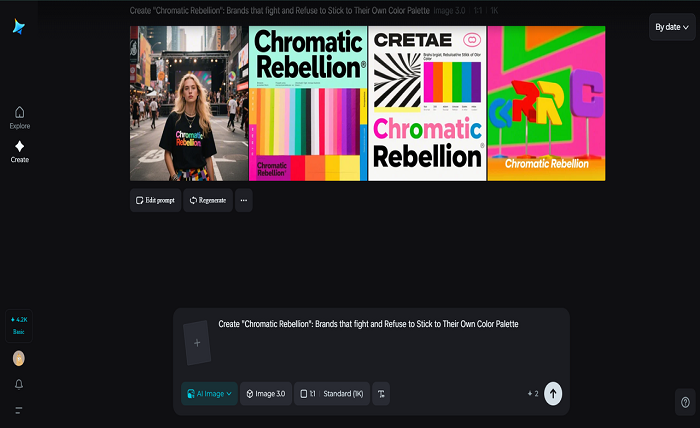
Brand colors used to be sacred. The blue of a logo could never deviate from Pantone 286C; the packaging yellow must be replicated to the last pixel. Consistency was code. But between digital anarchy and emotional branding, a new uprising started — a color uprising in which brands no longer answer to their own palettes. They morph, evolve, and throb with mood.
Now, color isn’t a prison — it’s a wave. And tools such as Dreamina, fueled by its AI photo generator allow creators to experiment with how colors move with feeling, time of year, or narrative. In today’s world of sensory storytelling, color becomes language — one that shifts its tone halfway through the sentence, and the effect is much more vibrant.
The color mutiny: zhen identity ceases to be fixed
Today’s brands don’t want to appear identical day after day. Their consumers shift mood, their offerings change, and their ads come alive. Why must their color scheme remain static?
This color insurrection is the antidote to predictability. It’s conversation through color — allowing your imagery to react to circumstance rather than telling it what to be.
Imagine this:
-
A coffee company that replaces its traditional brown hues with cool blues during a summer launch.
-
A fashion brand whose logo goes red for its Valentine line, and violet for Pride month.
-
A skincare campaign whose pastel colors darken to deep greens every time the brand addresses sustainability.
It’s not about shattering identity — it’s about enriching it.
Emotional chromatics and the modern brand mood
Colors don’t simply ornament; they convey. A single color can make or break the way an audience reacts to a message. That’s why brands are dropping static palettes for dynamic emotional tones.
A chromatic rebel brand maps the temperature of its images — shifting hue by emotional intention. Warm for closeness, cool for distance, metallic for vitality. The viewer starts to link not a color, but an emotion to the brand.
The movement also lives on digital-first designs. On social media, static color rules appear like uniforms; flowing color narratives appear human.
Color as personality, not property
A color palette was once like a uniform — strict, clean, and predictable. Today, brands approach color like personality: malleable, moody, sometimes volatile, but unmistakably theirs.
When well executed, chromatic rebellion will feel like jazz — there’s still form, but each note is improvised against emotion and intent.
These are what these new color systems look like:
-
Seasonal changes: Adapting hue colors to fit the mood of nature (e.g., rich amber colors during fall, radiant cyan during spring).
-
Cultural connection: Scaling color hues to match indigenous celebrations, art school styles, or conventional norms.
-
Digital fluidity: Allowing gradients or colors filters to change in real time for motion content.
Color, in essence, comes to life — altering form the way sound alters frequency.
Painting with mood: creating your own color revolution with Dreamina
Dreamina does all this innovative rebellion just wonderfully intuitively. It doesn’t impose brand templates — it hears your intention and converts description into tone, tone into color, and color into storytelling. By creating an overhauled campaign image or experimenting with other palettes for a seasonal look, Dreamina converts color rules into living art.
Step 1: Write a descriptive text prompt
Head to Dreamina and dream up your color revolution. Ditch your go-to color palette — begin with feeling. What does your brand currently feel like? Perhaps it’s electric and confident or celestial and relaxed. Write that into your prompt.
For instance: A high-end fragrance print ad of a bottle capped in swirling silk fabric, changing from gold to dark green to indigo, movie-light, high-contrast, shiny surface, ultra-realistic, poetic, and refined.
That amount of detail instructs Dreamina to favor emotional depth and color flow over fixed branding — a defiance coded in pixels.

Step 2: Refine parameters and create
Refine your creation by choosing your desired model, opting for an aspect ratio appropriate for your design intent (portrait for posters, landscape for banners), and tweaking size and resolution — 1K for mood drafts or 2K for campaign-ready art. Next, click Dreamina’s icon to create. What you see next will amaze you — a reinterpretation of your brand mood in color motion. Every tone will be emotionally deliberate, not arbitrary — because Dreamina interprets color by feeling, not equation.

Step 3: Edit and download
When your defiant color idea is formed, take it further with Dreamina’s editing capabilities. Employ inpaint to alter areas with new colors, expand to increase your canvas, remove to eliminate distractions, and retouch to perfect gradients or lighting transitions. After it’s complete, click Download to preserve your color experiment. You will have a visual that communicates emotionally instead of symbolically — a brand-artwork that came to existence out of instinct rather than adherence.

The new semiotics of hue
In this new age of chromatic rebellion, color theory is nuanced and covered more than standard practice — it’s about contrast and contradiction. Contemporary campaigns are testing how antagonistic hues can exist side by side in authentic ways.
One campaign could present three vastly disparate palettes, one for each aspect of identity: energetic boldness, thoughtful reserve, or virtual otherworldliness. Rather than a single identifying color, change itself becomes the brand emblem.
This is where Dreamina’s
AI logo generator comes into unexpected play. Rather than a single fixed logo, brands can utilize it to generate dynamic logo versions — changing colors to fit emotion, context, or even a time of day. Picture a logo that pulses in sync with your campaign beat: morning coral, midday gold, twilight violet. Identity is kinetic.

Grasping visual unexpectedness
Audiences are visual omnivores these days — they hunger for freshness, surprise, and sensorial stimulation. A strict color identity is old-fashioned; an adaptive one is human.
Color rebellion isn’t anarchy — it’s rhythm. It’s the dance of delivering coherence and liberty at the same time. Brands that recognize this tension don’t ditch consistency — they redefine it. Their palette is not a prison; it’s a spectrum on which they dance.
The following are a couple of innovative practices driving this new look:
-
Mood-syncing visuals: Drawing inspiration from everyday mood boards or playlists to determine color tone.
-
Interactive gradients: Allowing campaign backgrounds or animations to change color in response to real-time data or viewer engagement.
-
Contrast storytelling: Combining improbable color combinations (such as neon and beige, or midnight blue and lemon) to shock the eye.
When you’re able to edit colours without constraint,
Dreamina’s AI image editor is your best friend — tweaking hues, altering tones, adding elements, and playing without loss. You can marry rebellion with accuracy — making the untamed look deliberate.
When colors tell human stories
The elegance of breaking your palette is that it allows your brand to speak more humanly — an adaptive, contradictory, and emotive language. Colors are like emotions: fleeting but significant. The sky doesn’t remain blue, and neither will your brand.
Today’s audiences relate to authenticity over sameness. When a brand takes the risk of shifting its tone — visual and emotional — it is a sign of evolution, self-awareness, and boldness. It becomes not a logo, but a living narrative.
Chromatic courage and the art of reinvention
In the age of visual excess, Dreamina is the design partner for any designer, marketer, and dreamer willing to color in their identity. It does not simply create images — it stage-manages color experiences.
With its blend of instinct and accuracy, Dreamina enables you to experiment with tone, texture, and emotion without constraint. A brand color no longer constrains you; it speaks for you — differently, each time.
So go ahead — make your pinks moss green, your blacks glimmer into silver. The palette police no longer patrol. Dreamina reigns, and rebellion is beautiful.